A bone marrow biopsy is a medical procedure used to collect a small sample of soft tissue from inside a bone for laboratory examination.
Bone Marrow Biopsy and Aspiration
What is a bone marrow biopsy?
A bone marrow biopsy is a medical procedure used to collect a small sample of soft tissue from inside a bone for laboratory examination.
Bone marrow is the soft, spongy tissue found inside certain bones. It contains stem cells that develop into the different types of blood cells:
- Red blood cells: Carry oxygen throughout the body.
- White blood cells: Help the body fight infections.
- Platelets: Help blood clot and prevent excessive bleeding.
A bone marrow examination helps doctors investigate abnormalities in blood cell production and identify certain blood disorders, bone marrow diseases, and cancers.
The procedure commonly involves two tests: bone marrow aspiration, which collects liquid marrow, and bone marrow biopsy, which collects a small core of solid marrow tissue. Both are often performed during the same appointment.
What is bone marrow aspiration?
Bone marrow aspiration is a procedure in which a small amount of the liquid portion of the bone marrow is withdrawn using a needle and syringe.
The collected sample contains developing blood cells that can be examined under a microscope and used for additional laboratory tests.
Aspiration is commonly performed together with a bone marrow biopsy to provide more detailed information about blood cell production and the condition of the bone marrow.
What is the difference between bone marrow aspiration and biopsy?
Although these procedures are often performed together, they collect different types of samples.
Bone marrow aspiration
- Collects the liquid portion of the bone marrow.
- Uses a needle and syringe to withdraw the sample.
- Helps evaluate individual blood cells and their development.
- May be used for specialised laboratory tests.
Bone marrow biopsy
- Collects a small solid core of bone marrow tissue.
- Uses a specialised biopsy needle.
- Helps assess the structure, cellularity, and overall condition of the marrow.
- Provides information that may not be available from aspiration alone.
Together, these tests can provide a more complete assessment of the bone marrow.
Why might I need a bone marrow biopsy?
Your doctor may recommend a bone marrow examination when blood tests or other investigations show abnormalities that require further evaluation.
Common reasons include:
- Unexplained anaemia or low red blood cell counts
- Abnormally low or high white blood cell counts
- Low platelet counts or unexplained bleeding problems
- Persistent abnormalities in a complete blood count (CBC)
- Suspected blood or bone marrow disorders
- Investigation of certain blood cancers
- Evaluation of suspected bone marrow failure
- Assessment of unexplained fever in selected cases
- Checking how well treatment for a blood or bone marrow disease is working
- Monitoring whether a previously diagnosed condition has improved or progressed
The need for a biopsy depends on your symptoms, blood test results, medical history, and your doctor’s assessment.
Which conditions can a bone marrow biopsy help diagnose?
Bone marrow aspiration and biopsy can help diagnose or evaluate several conditions affecting blood cell production and the bone marrow.
These may include:
- Leukaemia: A group of cancers involving blood-forming tissues and abnormal white blood cells.
- Multiple myeloma: A cancer involving plasma cells, which are a type of white blood cell found in the bone marrow.
- Lymphoma: Certain types of lymphoma can involve or spread to the bone marrow.
- Myelodysplastic syndromes (MDS): Disorders in which blood cells do not develop normally.
- Myeloproliferative neoplasms (MPNs): Conditions in which the bone marrow produces excessive numbers of certain blood cells.
- Aplastic anaemia: A condition in which the bone marrow does not produce enough blood cells.
- Other blood disorders: Conditions associated with abnormal blood cell counts or production.
A bone marrow examination may also help determine whether certain cancers from other parts of the body have spread to the marrow.
Where is a bone marrow biopsy performed?
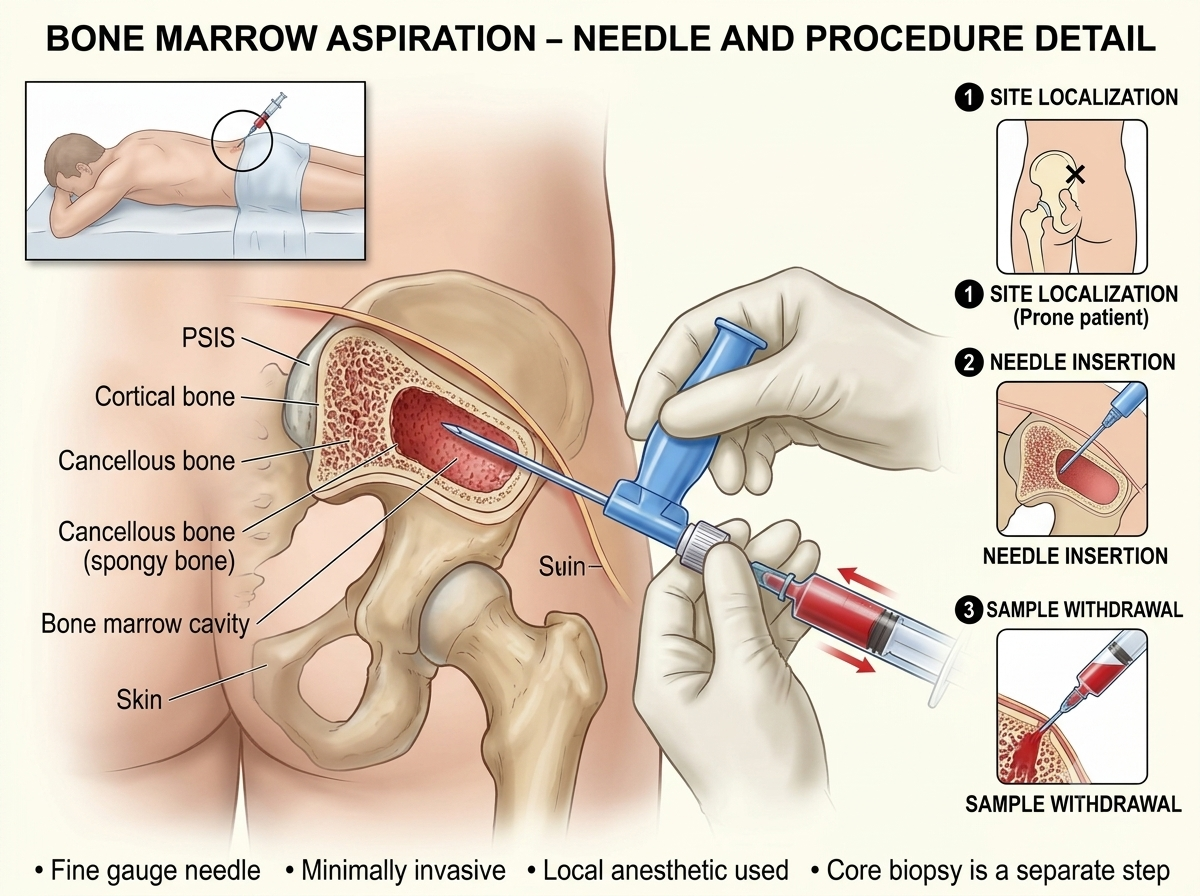
The most common site for a bone marrow biopsy is the posterior iliac crest, which is the upper part of the hip bone at the back of the pelvis.
This area provides access to the bone marrow and is generally considered a suitable location for collecting samples.
Depending on the patient’s condition and clinical requirements, another site may occasionally be considered.
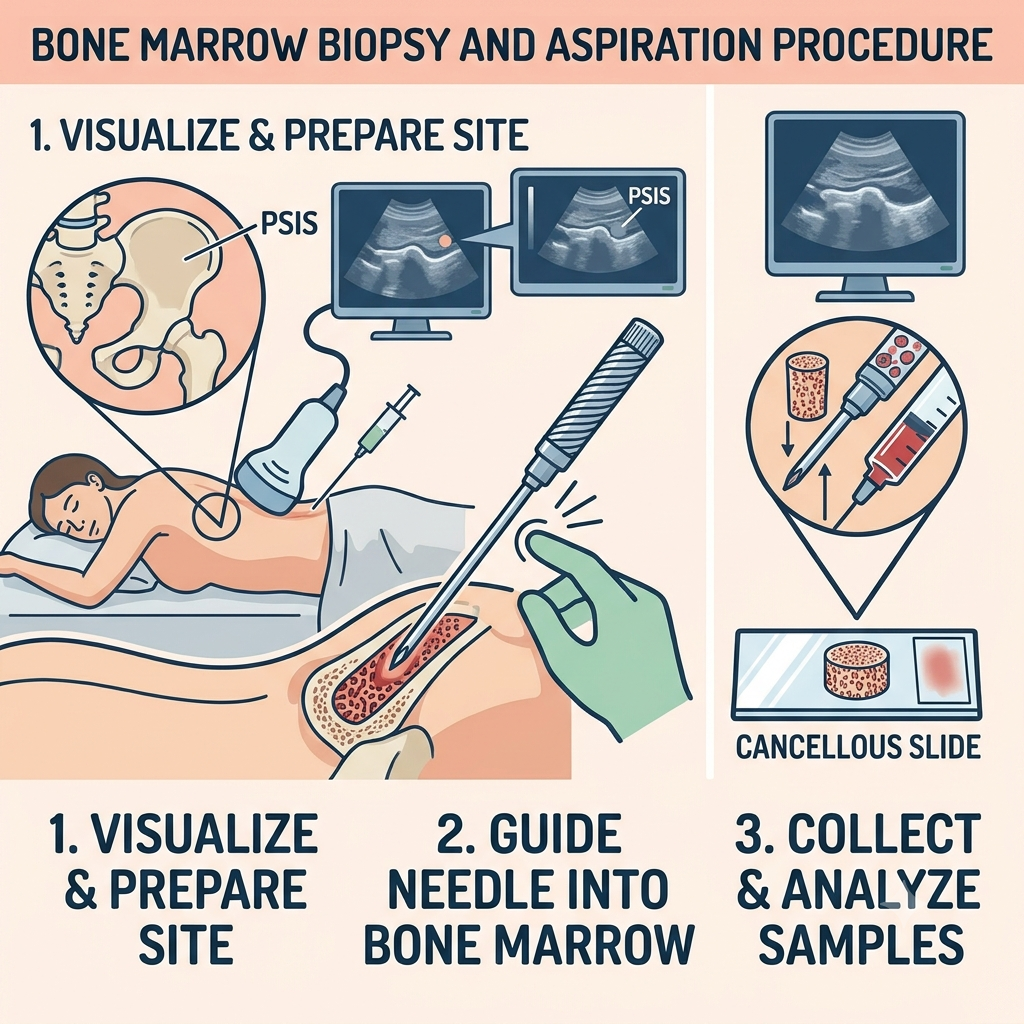
The procedure is usually performed in a hospital, clinic, or specialised procedure room. In selected cases, imaging guidance may be used to assist with needle placement.
How is a bone marrow biopsy performed?
Bone marrow aspiration and biopsy are generally performed as outpatient procedures.
The patient is positioned on their side or stomach to allow access to the back of the hip bone. Local anaesthesia is used to numb the skin and the surface of the bone.
The procedure generally involves the following steps:
- 1. Preparation
The healthcare team reviews the patient’s medical history, medications, allergies, and relevant blood test results. The patient is positioned comfortably, and the selected area is cleaned with an antiseptic solution. - 2. Local anaesthesia
Local anaesthetic is injected into the skin and the tissues surrounding the bone. This helps reduce discomfort during needle insertion. Sedation may also be considered when appropriate. - 3. Bone marrow aspiration
A specialised hollow needle is inserted through the skin into the bone. A syringe is attached to the needle to withdraw a small amount of liquid bone marrow.
Patients may experience a brief, sharp pulling sensation when the liquid marrow is collected. - 4. Bone marrow biopsy
A slightly larger biopsy needle is used to collect a small cylindrical core of solid bone marrow tissue.
The needle is carefully positioned within the bone, and the tissue sample is collected for laboratory examination. - 5. Completion
The needle is removed, and pressure is applied to the area to reduce bleeding. A sterile dressing is placed over the biopsy site.
The collected samples are sent to the laboratory for examination and any additional tests required.
How long does a bone marrow biopsy take?
The aspiration and biopsy procedures commonly take around 10–30 minutes, although the overall appointment may take longer.
Additional time may be required for preparation, administration of medication, monitoring, and recovery, particularly if sedation is used.
Most patients can return home on the same day if their condition is stable and the healthcare team considers discharge appropriate.
Is a bone marrow biopsy painful?
The level of discomfort varies from person to person.
Local anaesthesia is used to numb the skin and the surface of the bone. Patients may feel pressure when the needle is inserted.
During bone marrow aspiration, some people experience a brief, sharp pulling or aching sensation as the liquid marrow is withdrawn.
During the biopsy, patients may feel pressure or a dull discomfort while the small tissue core is collected.
If you feel significant pain or discomfort during the procedure, inform the doctor or nurse. Additional measures may be available to improve comfort.
How should I prepare for a bone marrow biopsy?
Preparation is usually straightforward, but instructions may vary depending on the patient’s medical condition and whether sedation will be used.
Before the procedure:
- Inform your doctor about all medications you take, including blood thinners, aspirin, vitamins, and supplements.
- Tell the healthcare team if you have a bleeding disorder or a history of unusual bleeding.
- Inform your doctor about any allergies, especially to local anaesthetics or other medications.
- Follow instructions about eating and drinking. Fasting may not be necessary for a procedure performed with local anaesthesia alone.
- Ask whether you need to arrange someone to accompany you home if sedation is planned.
- Wear comfortable clothing that allows access to the hip area.
Important: Do not stop taking prescribed blood thinners or other medications without instructions from your treating doctor.
What happens after a bone marrow biopsy?
After the samples are collected, pressure is applied to the biopsy site to reduce bleeding. A sterile dressing is placed over the area.
Patients are usually asked to remain lying down for a short period while the healthcare team checks the biopsy site and monitors recovery.
After the procedure, you may experience:
- Mild soreness around the biopsy site
- Bruising or tenderness near the hip
- Temporary discomfort when moving or changing position
- Mild stiffness around the lower back or hip area
These symptoms generally improve over the following days, although some tenderness may last for a week or longer.
Follow the wound-care and activity instructions provided by your healthcare team.
What are the benefits of a bone marrow biopsy?
Bone marrow aspiration and biopsy provide important diagnostic information that may not be available from routine blood tests alone.
Potential benefits include:
- Detailed examination: Provides information about blood cell production and the structure of the bone marrow.
- Diagnostic support: Helps investigate unexplained blood count abnormalities and suspected marrow disorders.
- Cancer evaluation: Can help diagnose certain blood cancers and determine whether some cancers involve the bone marrow.
- Treatment monitoring: May help assess how well a patient is responding to treatment.
- Targeted diagnosis: Helps doctors make more informed decisions about further investigations and treatment.
- Outpatient procedure: Most patients do not require an overnight hospital stay.
The results are interpreted alongside blood tests, medical history, imaging, and other relevant investigations.
Is a bone marrow biopsy safe? What are the possible risks?
Bone marrow aspiration and biopsy are generally safe procedures. However, complications can occur, although serious problems are uncommon.
Possible risks include:
- Pain or tenderness at the biopsy site
- Bruising around the area
- Bleeding, particularly in patients with low platelet counts or bleeding disorders
- Infection at the puncture site
- Prolonged discomfort around the biopsy area
- Rare complications related to sedation or medication
Your healthcare team will review your medical history and blood test results to assess the risks before proceeding.
How long does it take to recover from a bone marrow biopsy?
Recovery is usually relatively quick, and most patients can return home on the same day.
Some tenderness or bruising around the biopsy site is common and may last for several days or longer.
For a comfortable recovery:
- Keep the dressing in place and dry for the period recommended by your healthcare team.
- Avoid strenuous physical activity and heavy lifting for the time advised.
- Avoid unnecessary pressure on the biopsy area.
- Take pain relief only as recommended by your doctor.
- Follow the instructions for bathing and wound care.
- Attend any recommended follow-up appointments.
Contact your healthcare provider if you notice persistent bleeding, increasing pain, swelling, redness, discharge, or fever.
When will I receive my bone marrow biopsy results?
The collected samples are sent to a laboratory for examination by specialists, including pathologists and haematopathologists.
The testing may involve:
- Microscopic examination: Evaluates the appearance, number, and development of blood cells and marrow tissue.
- Immunophenotyping or flow cytometry: Helps identify specific types of abnormal blood cells.
- Cytogenetic testing: Examines chromosome changes in the cells.
- Molecular testing: Looks for specific genetic changes associated with certain diseases.
Not every patient requires all these tests. The investigations depend on the suspected condition and the initial findings.
The time required to receive the final results varies depending on the tests requested. Your treating doctor will explain the findings and discuss the next steps.
Does a bone marrow biopsy detect cancer?
A bone marrow examination can help diagnose several cancers involving the blood and bone marrow, including leukaemia and multiple myeloma.
It can also help determine whether certain cancers that started elsewhere in the body have spread to the bone marrow.
However, a bone marrow biopsy does not detect every type of cancer. The test is selected when there is a specific clinical reason to investigate the bone marrow.
The results must be interpreted alongside other investigations and the patient’s overall clinical condition.
Can a bone marrow biopsy diagnose the cause of anaemia?
Yes. A bone marrow examination may help investigate certain types of unexplained anaemia, particularly when routine blood tests do not provide enough information.
It allows doctors to examine how blood cells are being produced and whether the marrow is functioning normally.
However, not every patient with anaemia needs a bone marrow biopsy. Many cases can be evaluated using blood tests and other less invasive investigations first.
Your doctor will determine whether a bone marrow examination is necessary based on your individual findings.
What happens if the bone marrow biopsy results are abnormal?
An abnormal result does not always mean that cancer is present.
The findings may indicate changes in blood cell production, inflammation, bone marrow failure, or another blood or marrow disorder.
Depending on the results, your doctor may recommend:
- Additional blood tests
- Flow cytometry or genetic testing
- Further imaging or investigations
- Consultation with a haematologist
- Treatment or monitoring based on the diagnosed condition
Your treating specialist will explain what the results mean and whether further evaluation is required.
Is bone marrow biopsy the same as a bone biopsy?
No. A bone marrow biopsy and a bone biopsy are different procedures.
Bone marrow biopsy
- Collects a sample of the soft, spongy tissue inside a bone.
- Helps investigate blood cell production and bone marrow disorders.
- Is commonly performed using the hip bone as the sampling site.
Bone biopsy
- Collects a sample of the hard bone tissue itself.
- May be used to investigate a bone lesion, tumour, infection, or other bone abnormality.
- May use imaging guidance such as CT to target a specific area.
The appropriate procedure depends on the condition being investigated and the type of sample required.
Frequently asked questions about bone marrow biopsy
Is a bone marrow biopsy a major surgery?
No. It is a minimally invasive procedure performed using specialised needles. It generally does not require a large surgical incision or stitches.
Will I need to stay in the hospital overnight?
Usually not. Most bone marrow aspiration and biopsy procedures are performed on an outpatient basis, allowing patients to return home after a short observation period.
Can I eat before a bone marrow biopsy?
Fasting is often unnecessary when only local anaesthesia is used. However, if sedation or another form of anaesthesia is planned, different instructions may apply. Follow the instructions provided by your healthcare team.
Can I walk after a bone marrow biopsy?
Many patients can walk after the procedure once the healthcare team has checked the biopsy site and confirmed that recovery is satisfactory. Avoid strenuous activities for the period recommended by your doctor.
How long will the biopsy site remain sore?
Mild soreness and tenderness may last for several days or up to a week or longer. Contact your healthcare provider if pain becomes severe or continues to worsen.
Does a bone marrow biopsy weaken the bone?
The procedure removes only a small sample of marrow tissue. Significant bone damage is uncommon, and the sampling site generally heals without major problems.
Can a bone marrow biopsy be repeated?
Yes. A repeat examination may be recommended when additional information is needed, when an earlier sample was insufficient, or when a doctor needs to monitor a diagnosed condition or response to treatment.
What should I do if the biopsy site starts bleeding?
Apply gentle, firm pressure over the dressing and contact your healthcare provider for instructions. Seek urgent medical attention if bleeding is heavy or does not stop.
Need further evaluation of an abnormal blood test?
A bone marrow aspiration and biopsy can help investigate unexplained blood count abnormalities and provide important information about the health of your bone marrow.