A liver biopsy is a medical procedure in which a small sample of liver tissue is collected for laboratory examination.
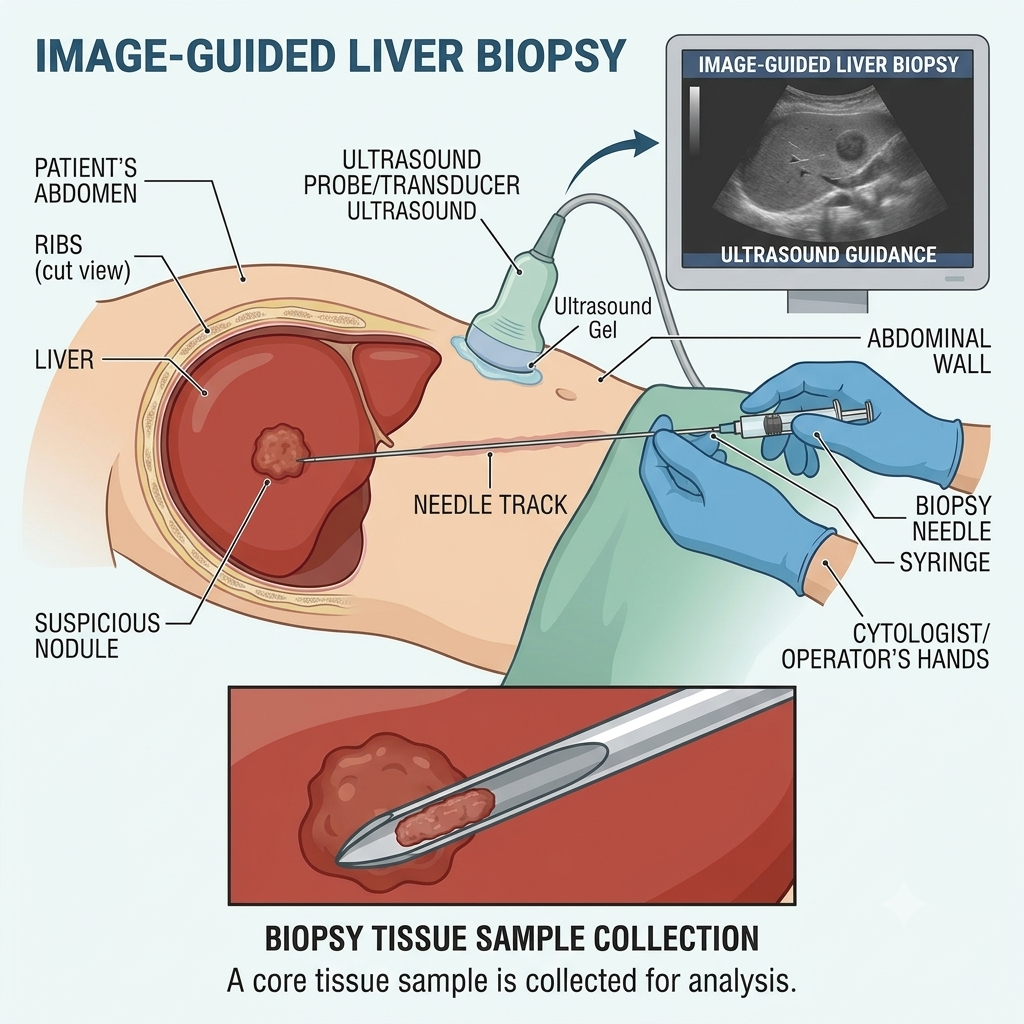
Liver Biopsy – Image-Guided Liver Biopsy
What is a liver biopsy?
A liver biopsy is a medical procedure in which a small sample of liver tissue is collected for laboratory examination.
The liver is an important organ located in the upper right part of the abdomen, beneath the rib cage. It performs several essential functions, including processing nutrients, filtering harmful substances from the blood, producing bile, and helping regulate blood clotting.
A liver biopsy allows doctors to examine liver tissue under a microscope to identify signs of inflammation, damage, scarring, infection, or abnormal cell growth.
The procedure may be recommended when blood tests, ultrasound, CT scans, MRI, or other investigations do not provide enough information to establish a diagnosis or determine the extent of liver disease.
What is an image-guided liver biopsy?
An image-guided liver biopsy is a minimally invasive procedure in which ultrasound or CT imaging helps the specialist identify the appropriate area of the liver and guide the biopsy needle.
The specialist uses a specialised needle to collect a small tissue sample. The sample is then sent to a laboratory for examination by a pathologist.
Image guidance helps the specialist plan the safest route to the target area while avoiding nearby organs and blood vessels.
Depending on the patient’s medical condition, a liver biopsy may be performed through the skin (percutaneous approach) or through a vein in the neck (transjugular approach).
Why might I need a liver biopsy?
Your doctor may recommend a liver biopsy when other tests suggest a possible liver problem or when additional information is needed to guide treatment.
Common reasons include:
- Investigating unexplained abnormalities in liver function blood tests
- Evaluating suspected liver inflammation or damage
- Assessing the severity of liver disease
- Identifying the cause of certain liver conditions
- Evaluating suspected liver fibrosis or cirrhosis
- Investigating an abnormal growth or lesion in the liver
- Assessing suspected liver involvement from another disease
- Evaluating a liver condition when blood tests and imaging do not provide a clear diagnosis
- Monitoring certain liver conditions or assessing response to treatment
- Evaluating selected cases following liver transplantation
Not everyone with abnormal liver blood tests needs a biopsy. Your doctor will consider your symptoms, medical history, blood test results, and imaging findings before recommending the procedure.
Which liver conditions can a biopsy help diagnose?
A liver biopsy can help doctors investigate and evaluate several conditions affecting the liver.
These may include:
- Fatty liver disease: Helps assess inflammation and liver damage in selected patients with metabolic dysfunction-associated steatotic liver disease (MASLD).
- Hepatitis: May help evaluate liver inflammation associated with certain viral, autoimmune, or other causes of hepatitis.
- Liver fibrosis: Helps assess the development and extent of scar tissue in the liver.
- Cirrhosis: May help confirm or evaluate advanced liver scarring when other tests are inconclusive.
- Autoimmune hepatitis: Can help identify characteristic patterns of liver inflammation.
- Drug-induced liver injury: May help investigate liver damage associated with certain medications or substances.
- Liver tumours: May help identify the nature of a selected liver lesion when tissue diagnosis is required.
- Other liver disorders: May help investigate less common conditions affecting liver tissue.
The biopsy findings are interpreted alongside blood tests, imaging, and the patient’s clinical history.
What are the different types of liver biopsy?
The appropriate biopsy technique depends on the patient’s condition, the location of the target, and the risk of complications.
The main approaches include:
- 1. Percutaneous liver biopsy
This is the most common approach. A biopsy needle is inserted through the skin of the abdomen or right side of the chest into the liver to collect a tissue sample.
Ultrasound or CT imaging may be used to identify the target and guide needle placement. - 2. Transjugular liver biopsy
In this approach, a thin catheter is inserted through a vein in the neck, usually the internal jugular vein. The catheter is guided through the veins toward the liver, and a specialised needle is used to collect a tissue sample.
This method may be recommended for patients with an increased risk of bleeding, certain blood-clotting problems, or fluid accumulation in the abdomen (ascites). - 3. Laparoscopic or surgical liver biopsy
In selected cases, a surgeon may collect a liver tissue sample using laparoscopic or open surgical techniques. This may be performed when another surgical procedure is already planned or when a different approach is required.
Your specialist will determine which technique is most appropriate for your medical condition.
How is an ultrasound-guided liver biopsy performed?
A percutaneous ultrasound-guided liver biopsy is generally performed in a specialised procedure room or interventional radiology department.
The patient usually lies on their back, with the right arm positioned above or behind the head to provide access to the liver.
The procedure generally involves the following steps:
- 1. Preparation
The healthcare team reviews the patient’s medical history, medications, allergies, blood test results, and relevant imaging. The patient is positioned comfortably, and the selected area is cleaned with an antiseptic solution. - 2. Ultrasound examination
An ultrasound probe is used to examine the liver and identify a suitable location for the biopsy. The specialist plans the safest route for the needle. - 3. Local anaesthesia
Local anaesthetic is injected into the skin and deeper tissues to numb the biopsy area. The patient may feel a brief stinging or burning sensation during the injection.
Sedation may also be provided when appropriate. - 4. Needle insertion
A small puncture is made in the skin, and a specialised biopsy needle is carefully guided into the liver using imaging guidance.
The patient may be asked to breathe out and briefly hold their breath while the tissue sample is collected. This helps reduce movement of the liver during needle placement. - 5. Sample collection
A small piece of liver tissue is collected using the biopsy needle. Depending on the clinical requirement, more than one sample may be obtained. - 6. Completion
The needle is removed, and pressure is applied to the biopsy site. A sterile dressing is placed over the puncture.
The collected tissue is sent to the laboratory for examination.
Is a liver biopsy a minimally invasive procedure?
Yes. A percutaneous needle liver biopsy is considered minimally invasive because it uses a small needle puncture rather than a large surgical incision.
The procedure is generally performed using local anaesthesia. Sedation may be provided when needed.
Ultrasound or CT guidance helps the specialist identify the target and plan the needle route.
Many patients can return home on the same day after an observation period. However, some patients may need an overnight stay depending on their medical condition, biopsy technique, and recovery.
Although minimally invasive, liver biopsy is still a medical procedure with potential risks, particularly bleeding. Your specialist will assess whether it is suitable for you.
Who may be a suitable candidate for an image-guided liver biopsy?
A liver biopsy may be recommended for patients who require tissue examination to investigate a liver abnormality or guide treatment.
It may be considered when:
- Blood tests suggest unexplained liver abnormalities.
- Imaging identifies a liver lesion that requires tissue diagnosis.
- The cause or severity of liver disease remains uncertain.
- Additional information is needed to assess liver inflammation or scarring.
- A tissue sample is required to investigate a suspected liver condition.
- The results may influence the patient’s treatment plan.
Not every patient with liver disease is suitable for a percutaneous biopsy. Patients with certain blood-clotting problems, significant abdominal fluid accumulation, or other medical conditions may require an alternative approach.
Your doctor will review your test results and medical history before deciding on the safest biopsy method.
How should I prepare for a liver biopsy?
Preparation depends on the type of biopsy and the patient’s medical condition.
Before the procedure:
- Inform your doctor about all medications you take, including blood thinners, aspirin, pain relievers, vitamins, and herbal supplements.
- Tell your healthcare team about any allergies, especially to local anaesthetics, sedatives, or contrast materials.
- Inform your doctor if you have a history of bleeding problems or blood-clotting disorders.
- You may need blood tests to assess your platelet count and blood-clotting function.
- Follow instructions regarding fasting. Your doctor may ask you to avoid eating and drinking for several hours before the procedure.
- Arrange for someone to accompany you home if sedation is planned.
- Wear comfortable clothing and follow any additional instructions provided by the hospital.
Important: Do not stop taking blood thinners or other prescribed medications without specific instructions from your treating doctor.
What happens after a liver biopsy?
After the biopsy, the needle is removed and a dressing is placed over the puncture site.
You will be taken to a recovery area, where healthcare professionals monitor your blood pressure, pulse, and overall condition.
Depending on the biopsy technique and your medical condition, you may be asked to remain lying down for several hours.
After the procedure, you may experience:
- Mild pain or tenderness near the biopsy site
- Discomfort in the upper right part of the abdomen
- Mild pain that may be felt in the right shoulder
- Temporary soreness around the puncture area
These symptoms often improve over the following hours or days.
Follow the instructions provided by your healthcare team before leaving the hospital.
What are the benefits of an image-guided liver biopsy?
An image-guided liver biopsy provides a tissue sample that can help doctors understand the nature and extent of a liver condition.
Potential benefits include:
- Accurate tissue sampling: Provides liver tissue for detailed laboratory examination.
- Image guidance: Ultrasound or CT helps identify the target and plan the needle route.
- Diagnostic information: Helps investigate liver inflammation, fibrosis, certain tumours, and other liver disorders.
- Treatment planning: Findings may help doctors select appropriate treatment.
- Disease assessment: Can help evaluate the severity of certain liver conditions.
- Minimally invasive approach: A needle biopsy generally avoids the need for a large surgical incision.
- Outpatient procedure: Many patients can return home after a period of observation.
The benefits depend on the reason for the biopsy and whether the sample provides sufficient information for diagnosis.
Is a liver biopsy safe? What are the possible risks?
Liver biopsy is generally considered a safe procedure when performed by an appropriately trained specialist. However, complications can occur.
Possible risks include:
- Pain or tenderness around the biopsy site
- Bleeding from the liver or internally into the abdomen
- Bruising or a collection of blood near the biopsy site
- Infection
- Injury to nearby organs or structures
- Leakage of bile from the liver or nearby bile ducts
- Rare complications involving the lung or surrounding chest cavity
- An allergic reaction to medications or contrast material, when used
- An inadequate sample that may require repeat biopsy or additional testing
Bleeding is an important complication that the healthcare team assesses for before and after the procedure.
Your doctor will review your blood tests, medical history, and imaging findings to determine the safest approach and discuss the risks relevant to your condition.
How long does it take to recover from a liver biopsy?
Recovery varies depending on the type of biopsy, the patient’s overall health, and whether sedation was used.
Many patients return home on the same day after a period of monitoring. Some may need to stay overnight for observation.
Mild discomfort around the biopsy area or right shoulder may occur for a few days.
For a comfortable recovery:
- Rest for the period recommended by your healthcare team.
- Keep the biopsy site clean and follow dressing instructions.
- Avoid heavy lifting and strenuous physical activity for the period advised, often around one week after a percutaneous biopsy.
- Do not drive or operate machinery for the period specified by your doctor if sedation was used.
- Take pain relief only as recommended by your healthcare professional.
- Attend follow-up appointments as advised.
Seek urgent medical attention if you experience severe or worsening abdominal pain, dizziness, fainting, fever, difficulty breathing, or significant bleeding.
When will I receive my liver biopsy results?
The collected liver tissue is sent to a laboratory, where a pathologist examines the sample under a microscope.
The report may provide information about:
- Signs of inflammation
- Fat accumulation in liver cells
- Liver cell damage
- Fibrosis or scarring
- Features of cirrhosis
- Abnormal or cancerous cells, when present
- Other changes associated with liver disease
Depending on the clinical question, additional laboratory tests may be required.
Results are often available within several days to about a week, although the time can vary depending on the laboratory and whether specialised tests are needed.
Your treating doctor will explain the findings and discuss whether further investigation or treatment is required.
Can a liver biopsy detect cancer?
Yes. A liver biopsy can help determine whether a suspicious liver lesion contains cancerous cells.
It may help distinguish between different types of liver tumours and, in selected cases, determine whether a lesion represents a primary liver cancer or cancer that has spread from another organ.
However, not every liver lesion requires a biopsy. Some can be diagnosed using characteristic imaging findings and blood tests.
The decision to perform a biopsy depends on the suspected diagnosis, imaging appearance, and whether tissue confirmation will influence treatment.
Can a liver biopsy detect fatty liver disease?
A liver biopsy can help assess certain forms of fatty liver disease by examining liver tissue for fat accumulation, inflammation, and scarring.
However, a biopsy is not routinely required for every person with fatty liver.
Doctors often use blood tests, ultrasound, and non-invasive assessments such as elastography to evaluate liver health and the likelihood of fibrosis.
A biopsy may be considered when the diagnosis remains uncertain, when more detailed assessment is needed, or when the findings may affect treatment decisions.
What is the difference between a liver biopsy and a liver function test?
Liver function tests and liver biopsy provide different types of information.
Liver function blood tests
- Require a blood sample.
- Measure substances such as liver enzymes, bilirubin, and proteins.
- Help identify possible liver injury or changes in liver function.
- Do not directly show the microscopic structure of liver tissue.
Liver biopsy
- Collects a small sample of liver tissue.
- Allows microscopic examination of liver cells and tissue structure.
- Can help identify inflammation, fibrosis, and certain other liver conditions.
- Is an invasive procedure with potential risks.
Your doctor may use blood tests, imaging, and biopsy findings together to assess your liver health.
What happens if the liver biopsy results are inconclusive?
Sometimes the tissue sample does not provide enough information to establish a clear diagnosis.
This may happen if the sample is too small, the affected area is difficult to target, or the tissue findings are not specific to one condition.
Depending on the situation, your doctor may recommend:
- Additional blood tests
- Further imaging, such as ultrasound, CT, or MRI
- Specialised laboratory testing of the tissue
- A repeat biopsy
- Monitoring over time
- Consultation with a liver specialist (hepatologist)
The next step depends on the biopsy findings and your overall clinical condition.
Frequently asked questions about liver biopsy
Is a liver biopsy a major surgery?
No. A needle liver biopsy is a minimally invasive procedure performed through a small puncture in the skin. It generally does not require a large surgical incision or stitches.
Will I need to stay in the hospital overnight?
Many patients return home on the same day after a period of observation. Some patients may require an overnight stay depending on their medical condition, biopsy technique, or recovery.
Is a liver biopsy painful?
Local anaesthesia is used to numb the biopsy area. You may feel a brief stinging sensation when the anaesthetic is injected and some pressure during needle insertion. Mild pain or right shoulder discomfort may occur afterward.
Can I eat before a liver biopsy?
Your doctor may ask you to fast for several hours before the procedure. The instructions depend on the type of biopsy and whether sedation will be used. Follow the specific instructions provided by your healthcare team.
Can I take my regular medications before the biopsy?
Some medications, particularly blood thinners and certain pain relievers, may need special instructions before the procedure. Do not stop any prescribed medication without consulting your doctor.
How long should I rest after a liver biopsy?
You will need to rest and remain under observation for several hours after the procedure. Your doctor may advise avoiding heavy lifting and strenuous activity for around one week, depending on your recovery.
Can a liver biopsy make liver disease worse?
The biopsy removes only a small sample of liver tissue. It is not intended to worsen liver disease. However, as with any invasive procedure, complications such as bleeding or infection can occur.
Does every patient with liver disease need a biopsy?
No. Many liver conditions can be evaluated using blood tests, ultrasound, CT, MRI, or non-invasive assessments. A biopsy is recommended only when additional tissue information is considered necessary.
What should I do if I experience severe pain after a liver biopsy?
Severe or worsening abdominal pain, persistent shoulder pain, dizziness, fainting, or a rapid heartbeat may indicate a complication such as internal bleeding. Seek urgent medical attention rather than waiting for the symptoms to settle.
Need further evaluation of a liver condition or abnormal liver imaging?
An image-guided liver biopsy can help doctors examine liver tissue, investigate an abnormality, and obtain information that may guide diagnosis and treatment.