A thyroid biopsy is a medical procedure used to collect cells or tissue from an abnormal area of the thyroid gland for examination in a laboratory.
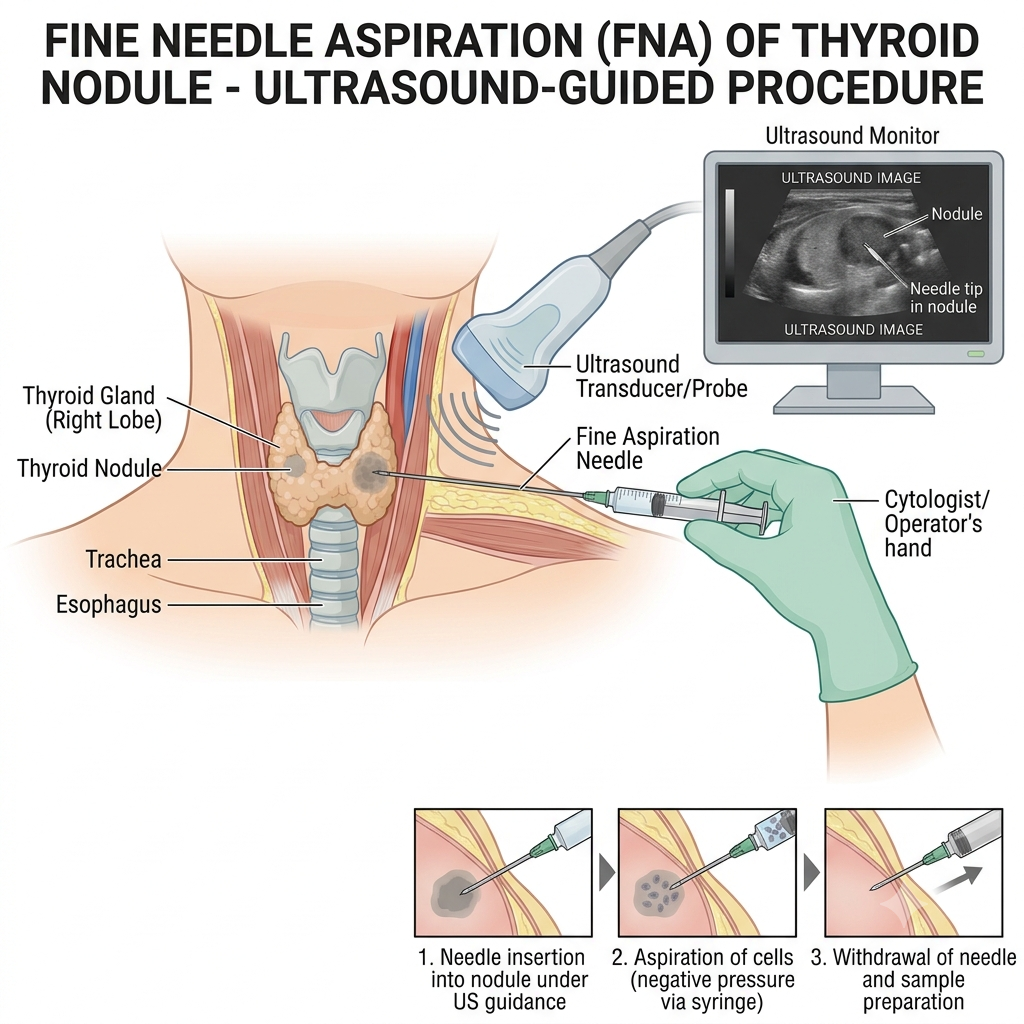
Thyroid Biopsy – Ultrasound-Guided Fine Needle Aspiration
What is a thyroid biopsy?
A thyroid biopsy is a medical procedure used to collect cells or tissue from an abnormal area of the thyroid gland for examination in a laboratory.
The thyroid is a small, butterfly-shaped gland located at the front of the neck. It produces hormones that help regulate the body’s metabolism, energy use, temperature, and other important functions.
A thyroid nodule is a lump or growth within the thyroid gland. Most thyroid nodules are benign (non-cancerous), but some may require further investigation to determine their nature.
A biopsy helps doctors evaluate a thyroid nodule when clinical assessment and imaging alone cannot provide enough information. The results can help guide decisions about monitoring, additional testing, or treatment.
What is an ultrasound-guided thyroid biopsy?
An ultrasound-guided thyroid biopsy is a minimally invasive procedure in which ultrasound imaging is used to guide a needle into a selected area of the thyroid gland.
The most common technique is fine needle aspiration (FNA), which collects cells from the thyroid nodule for laboratory examination. In selected cases, a core needle biopsy may be recommended to obtain a small sample of tissue.
Ultrasound provides real-time images of the thyroid, allowing the specialist to identify the target and guide the needle accurately.
The procedure is generally performed without a surgical incision and usually does not require an overnight hospital stay.
Why might I need a thyroid biopsy?
Your doctor may recommend a thyroid biopsy when an ultrasound or clinical examination identifies a nodule that requires further evaluation.
Reasons for a biopsy may include:
- A thyroid nodule with ultrasound features that warrant further investigation
- A lump in the neck that appears to arise from the thyroid gland
- A nodule that has changed in size or appearance and meets criteria for biopsy
- Enlarged or abnormal lymph nodes in the neck that require assessment
- A thyroid nodule that remains uncertain after other investigations
- Further evaluation of a previously identified thyroid abnormalit
Not every thyroid nodule needs a biopsy. The decision depends on factors such as its ultrasound appearance, size, clinical history, and relevant medical guidelines.
What are the symptoms of thyroid nodules?
Many thyroid nodules do not cause symptoms and are discovered during a routine examination or an imaging test performed for another reason.
When symptoms occur, they may include:
- A lump or swelling at the front of the neck
- A feeling of pressure in the neck
- Difficulty swallowing in some cases
- Discomfort when wearing tight collars
- Hoarseness or a change in voice
- Difficulty breathing if a large nodule presses on the airway
Thyroid nodules do not always cause changes in thyroid hormone levels. Some people have normal thyroid function despite having one or more nodules.
A new or enlarging neck lump, persistent hoarseness, or difficulty swallowing should be evaluated by a healthcare professional.
Does every thyroid nodule require a biopsy?
No. Many thyroid nodules are benign and can be monitored without a biopsy.
Your doctor will assess the nodule’s size, ultrasound characteristics, medical history, and other relevant findings to determine whether sampling is necessary.
Some nodules may only require periodic ultrasound examinations. Others may meet the criteria for fine needle aspiration or another form of investigation.
The recommendation for biopsy should be based on an individual assessment rather than the presence of a lump alone.
How is a thyroid biopsy performed?
An ultrasound-guided thyroid biopsy is usually performed as an outpatient procedure.
The patient lies on an examination bed with the head tilted slightly backward to provide access to the front of the neck.
The general steps include:
- 1. Preparation
The healthcare team confirms the target nodule and reviews the patient’s medical history, medications, allergies, and relevant imaging. The skin over the neck is cleaned with an antiseptic solution. - 2. Ultrasound examination
A small amount of ultrasound gel is applied to the neck. The specialist uses an ultrasound probe to identify the thyroid nodule and determine the safest route for the needle. - 3. Needle insertion
A very thin needle is carefully guided through the skin into the selected nodule. Local anaesthesia may be used, depending on the procedure and the specialist’s approach. - 4. Sample collection
The specialist collects cells from the nodule. Several samples may be taken to obtain enough material for laboratory analysis. The patient is usually asked to remain still and avoid talking, swallowing, or coughing while the needle is being positioned and samples are collected. - 5. Completion
The needle is removed, and gentle pressure is applied to the puncture site to reduce bleeding. A small dressing may be applied if needed.
The samples are sent to a laboratory for examination by a qualified pathologist or cytopathologist.
How long does a thyroid biopsy take?
An ultrasound-guided fine needle aspiration biopsy commonly takes less than 30 minutes, although the duration varies depending on the number of nodules being sampled and the complexity of the procedure.
Additional time may be needed for registration, preparation, observation, and discharge instructions.
Most patients can return home after the procedure once the healthcare team is satisfied that recovery is satisfactory.
Is a thyroid biopsy painful?
Most patients tolerate the procedure well. You may feel pressure from the ultrasound probe and a brief pinching sensation when the needle enters the skin or nodule.
Some patients experience mild discomfort during sample collection. Local anaesthesia may be used when appropriate.
After the biopsy, the neck may feel tender or sore for a day or two. This usually improves without significant intervention.
Tell the specialist if you feel unwell or experience substantial discomfort during the procedure.
How should I prepare for a thyroid biopsy?
Preparation is generally straightforward, and many patients do not need special preparation before an ultrasound-guided FNA.
Before your appointment:
- Tell your doctor about all medications you take, including aspirin, blood thinners, and supplements.
- Inform the healthcare team about any bleeding disorders or medication allergies.
- Follow the instructions provided by the facility regarding eating, drinking, and medication use.
- Wear comfortable clothing that allows easy access to the neck.
- Remove necklaces or other jewellery around the neck before the procedure.
Important: Do not stop blood thinners or other prescribed medications on your own. Your treating doctor will advise you whether any medication changes are needed.
What happens after a thyroid biopsy?
After the needle is removed, pressure is applied to the biopsy site. You may be observed briefly before being allowed to leave.
Most patients feel well after the procedure and can resume their usual activities, subject to the treating team’s instructions.
You may experience:
- Mild tenderness at the biopsy site
- Slight bruising
- Temporary neck discomfort
- Mild discomfort when moving the neck
These symptoms generally improve over the next day or two.
Follow the aftercare instructions provided by your healthcare team. Seek urgent medical attention if you develop rapidly increasing neck swelling, difficulty breathing, difficulty swallowing, or significant bleeding.
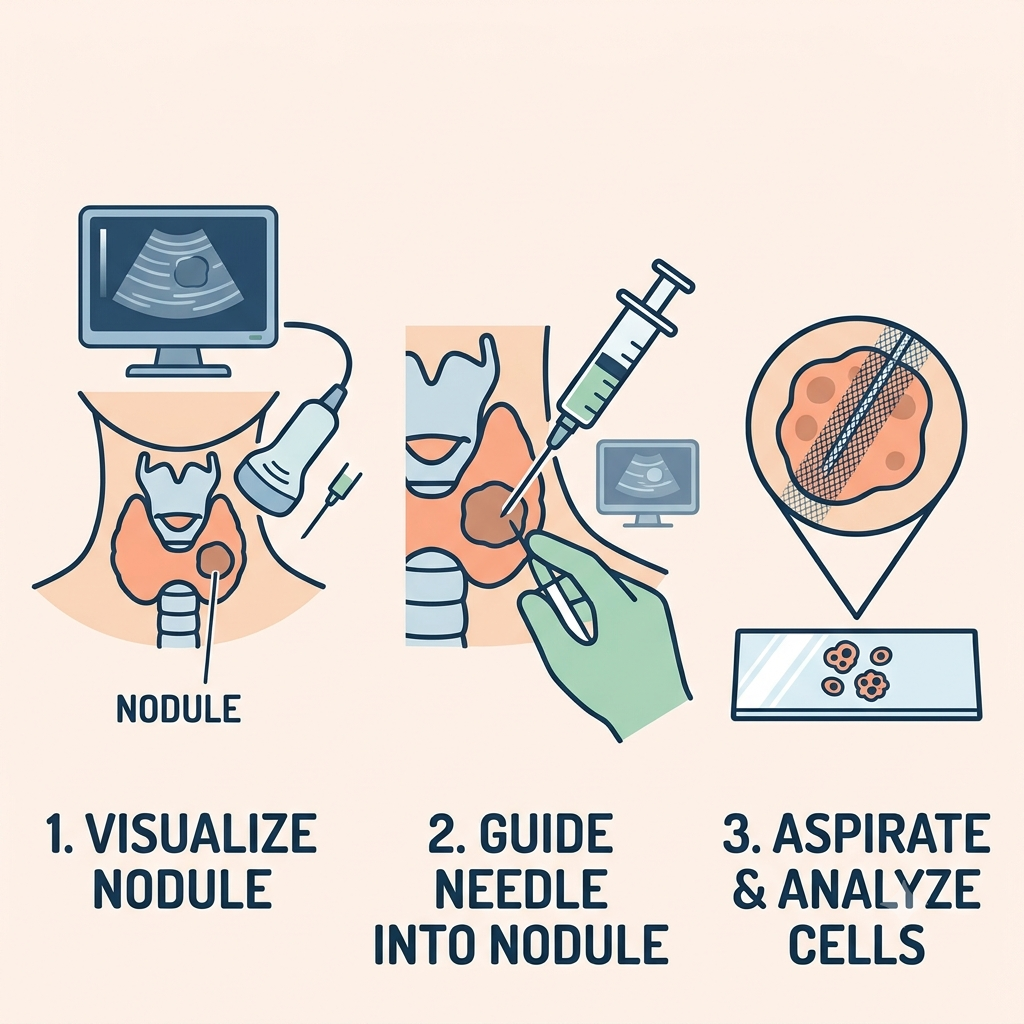
What are the benefits of an ultrasound-guided thyroid biopsy?
An ultrasound-guided thyroid biopsy can help doctors investigate thyroid nodules without requiring open surgery.
Potential benefits include:
- Minimally invasive procedure: Uses a fine needle through a small puncture in the skin.
- Real-time imaging: Ultrasound helps the specialist guide the needle toward the selected nodule.
- No surgical incision: The procedure generally does not require stitches.
- Short recovery: Most patients return to their usual activities relatively quickly.
- Outpatient treatment: An overnight hospital stay is usually unnecessary.
- Diagnostic information: Laboratory examination of the sample can help determine the appropriate next steps in care.
The usefulness of the biopsy depends on obtaining an adequate sample and interpreting the results alongside the patient’s clinical and imaging findings.
Is thyroid biopsy safe? What are the possible risks?
Ultrasound-guided thyroid FNA is generally considered a safe procedure, and serious complications are uncommon. However, no medical procedure is entirely without risk.
Possible risks include:
- Mild pain or tenderness at the biopsy site
- Bruising or bleeding beneath the skin
- Infection, which is uncommon
- An inadequate sample that does not provide a clear diagnosis
- The need for a repeat biopsy or additional testing
- Rare injury to nearby structures
Your doctor will review your medical history and explain any specific risks that may apply to you.
How long does it take to recover from a thyroid biopsy?
Recovery is usually quick.
Many patients can return to normal daily activities on the same day, depending on how they feel and the advice of their healthcare provider.
For a comfortable recovery:
- Follow the instructions given by the treating team.
- Keep the biopsy site clean and follow any dressing instructions.
- Use pain relief only as recommended by your healthcare professional.
- Avoid pressing or repeatedly touching the biopsy site.
- Contact your healthcare provider if pain or swelling increases rather than improves.
If you develop significant neck swelling, breathing difficulty, or difficulty swallowing, seek urgent medical care.
When will I receive my thyroid biopsy results?
The sample is examined in a laboratory by a qualified pathologist or cytopathologist.
The time required to receive results depends on the laboratory, the type of sample, and whether additional testing is necessary. Your healthcare provider will explain when and how your results will be communicated.
The results help determine whether the nodule appears benign, suspicious, malignant, or whether the sample is insufficient or indeterminate.
A biopsy result should always be interpreted alongside the ultrasound findings, clinical history, and any other relevant investigations.
What do thyroid biopsy results mean?
Thyroid FNA results are commonly reported using the Bethesda System for Reporting Thyroid Cytopathology. The report helps the treating doctor decide whether monitoring, repeat sampling, molecular testing, or surgical consultation may be appropriate.
Results generally fall into six categories:
- Nondiagnostic or unsatisfactory: The sample does not contain enough suitable material to reach a reliable conclusion. A repeat biopsy may be recommended.
- Benign: The sample does not show evidence of cancer. Follow-up may still be advised depending on the ultrasound findings and clinical situation.
- Atypia of undetermined significance or follicular lesion of undetermined significance: The sample contains changes that cannot be confidently classified as benign or malignant. Additional assessment may be required.
- Follicular neoplasm or suspicious for a follicular neoplasm: Further evaluation may be necessary because FNA alone cannot always distinguish certain follicular growths.
- Suspicious for malignancy: The findings raise concern for cancer and usually require specialist evaluation.
- Malignant: The sample contains cells consistent with thyroid cancer. Your treating doctor will discuss the appropriate next steps.
An indeterminate or suspicious result does not always mean that cancer is present. Your doctor will explain the significance of the specific result and whether further testing is needed.
Can a thyroid biopsy detect cancer?
A thyroid biopsy can help determine whether a thyroid nodule contains cells that are benign or malignant.
It is an important diagnostic tool, but the result is not always conclusive. Sometimes the sample does not contain enough cells, or the cellular changes cannot be clearly classified.
In these situations, your doctor may recommend repeat sampling, additional tests, monitoring, or a surgical assessment.
A benign result may still require follow-up if the ultrasound appearance or clinical findings remain concerning.
What happens if the biopsy result is inconclusive?
An inconclusive result means that the sample has not provided enough information to establish a clear diagnosis.
This may occur if the sample contains too few cells or if the findings fall into a category that requires further assessment.
Depending on the results and ultrasound findings, your doctor may recommend:
- A repeat ultrasound-guided biopsy
- Continued ultrasound monitoring
- Additional laboratory or molecular testing, where appropriate
- Consultation with an endocrinologist or thyroid surgeon
- Further investigation based on the overall clinical picture
The next step depends on the individual patient’s findings and should be decided with the treating specialist.
Is a thyroid biopsy the same as a core needle biopsy?
No. Fine needle aspiration and core needle biopsy are different techniques.
Fine needle aspiration (FNA)
- Uses a thin needle to collect cells from the thyroid nodule.
- Is commonly used for the initial evaluation of many thyroid nodules.
- Usually requires only a small puncture in the skin.
Core needle biopsy
- Uses a larger needle to obtain a small cylinder of tissue.
- May be considered in selected cases when additional tissue architecture is needed or when FNA results are inconclusive.
- Has different preparation and risk considerations depending on the circumstances.
Your specialist will recommend the technique that is most appropriate for the nodule and the clinical question being investigated.
Frequently asked questions about thyroid biopsy
Is thyroid biopsy a major surgery?
No. An ultrasound-guided fine needle aspiration biopsy is a minimally invasive procedure performed through a small puncture in the skin. It usually does not require a surgical incision or stitches.
Will I need to stay in the hospital overnight?
An overnight stay is generally not required for a routine thyroid FNA. Most patients can leave after the procedure and a brief observation period, if needed.
Can I eat before a thyroid biopsy?
Fasting is generally not required for a routine ultrasound-guided thyroid FNA. However, follow the specific preparation instructions provided by your healthcare team.
Can I take my regular medicines before the biopsy?
Many medications can be continued, but blood thinners and certain other medicines may require specific instructions. Never stop prescribed medication without consulting your treating doctor.
Can I speak or swallow during the procedure?
The specialist may ask you to remain still and avoid speaking, swallowing, or coughing while the needle is being positioned and samples are collected. This helps the procedure proceed safely and accurately.
Will the biopsy leave a scar?
A fine needle aspiration biopsy usually leaves little to no visible scarring because it uses a very small needle rather than a surgical incision.
Can a benign thyroid nodule become cancerous?
A benign biopsy result is reassuring, but follow-up may still be recommended based on the nodule’s ultrasound appearance, growth, and clinical findings. If the nodule changes or new concerns develop, your doctor may recommend further evaluation.
Does a thyroid biopsy affect thyroid hormone levels?
The biopsy is performed to collect cells or tissue from a nodule and is not intended to alter thyroid hormone production. Thyroid hormone levels are assessed using blood tests when clinically indicated.
What should I do if I notice swelling after the biopsy?
Mild tenderness or bruising can occur. However, rapidly increasing swelling, significant bleeding, difficulty breathing, or difficulty swallowing requires urgent medical assessment.